This line makes fuel pellets out of what a sawmill or a woodworking shop already throws away: slabs, edgings, offcuts, veneer waste, pallet scrap, and the sawdust from the cutting floor. Logs up to 25 cm in diameter go in at one end; 25 kg or 50 kg bags of 6 mm or 8 mm pellets come out at the other.
Where the pellets go: domestic pellet stoves and boilers in Europe, industrial biomass boilers, and power plants co-firing biomass. Every market has its own spec, so the die is chosen for the customer - 6 mm for the European stove market, 8 mm for Asian industrial boilers - and a 6.5-7 mm die can be supplied when a customer sells into both.
What the buyer usually is: a sawmill that wants to turn its own residue into a product instead of paying to have it hauled away; a wood-processing plant with a fixed supply of dry offcuts; a fuel trader who buys sawdust and sells bagged pellets under his own brand; a contractor putting up a 40-tonne-a-day plant for a local biomass programme.
The economics that matter to them are simple. A 2-3 t/h line runs 20 hours a day and makes 40-60 tonnes of pellets; the same tonne of raw material that was a disposal cost becomes a saleable bag. Payback on a line of this size is normally quoted at 8-12 months in a market with a steady raw material supply, which is why the first question we ask is never about the machine - it is about what raw material the customer can guarantee, at what moisture, and all year round.
parameter
Model WW-BPL1000 WW-BPL2000 WW-BPL3500
-------------------------------------------------------------------------------------------------------------------------
Output (t/h) 1-1.5 2-3 3-4
Raw material logs <= 25 cm, slabs, sawdust logs <= 25 cm, slabs, sawdust logs <= 30 cm, slabs, sawdust
Raw material moisture 15-55 % 15-55 % 15-55 %
Crusher 600 comprehensive 800 heavy-duty 800 heavy-duty
Crusher capacity (t/h) 4-5 6-8 6-8
Crusher motor (kW) 37 45 45
Hammer mill 1200 water-drop 1600 water-drop 1600 water-drop x 2
Hammer mill motor (kW) 55 90 90 each
Dryer 1.2 x 16 m stacked 1.5 x 16 m stacked 1.8 x 20 m stacked
Dryer capacity (t/h) 1.5-2 2.5-3 4-5
Burner (10,000 kcal) 120 240 360
Pellet mill 470 ring die x 1 470 ring die x 2 560 ring die x 2
Die inner diameter (mm) 470 470 560
Main motor (kW) 75 75 each 132 each
Mill output each (kg/h) 1000-1200 1000-1200 1500-2000
Pellet diameter (mm) 6 / 8 6 / 8 6 / 8
Pellet moisture 8-10 % 8-10 % 8-10 %
Bulk density (t/m3) 1.1-1.15 1.1-1.15 1.1-1.15
Cooler counter-flow 1.5 t/h counter-flow 3 t/h counter-flow 4 t/h
Packing 25-50 kg bag 25-50 kg bag 25-50 kg bag
Total installed power (kW) approx. 245 approx. 358 approx. 560
Workshop L x W x H (m) 24 x 12 x 8 32 x 15 x 9 42 x 18 x 10
Shipping 2 x 40HQ 3 x 40HQ 4 x 40HQ
Standard configuration, quoted per model. Crusher size, dryer length, number of pellet mills and burner rating are re-checked against your raw material, its moisture content, your local fuel and your target bag size before the contract. Installed power is the sum of the motors in the standard configuration and changes with conveyor length and layout.
principle
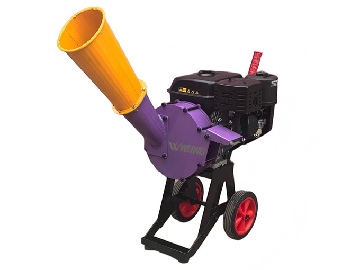
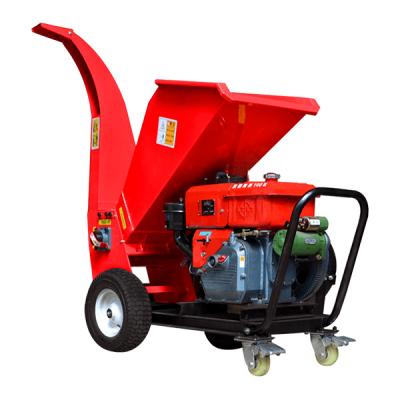
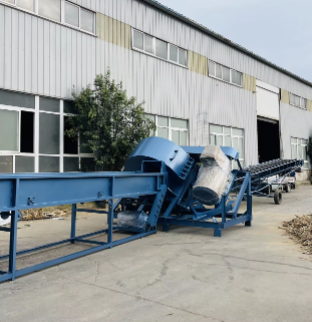
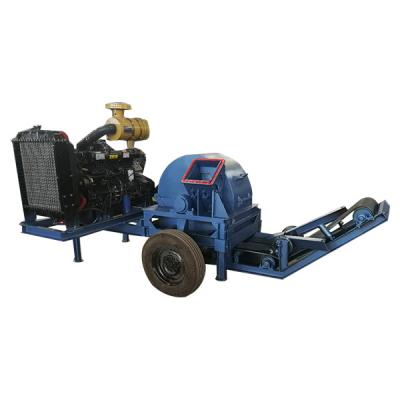
1. Crushing. Logs, slabs and pallet scrap are fed by a toothed chain conveyor into the crusher, where a heavy rotor with bolt-on blades or hammers breaks them down. The feed opening is rated for 25 cm logs; in practice we size it so the customer runs at about 80 % of the maximum opening, because a machine fed at its limit is a machine that stops every week. Everything downstream is sized from this figure: to make 3 tonnes of pellets you do not need 3 tonnes of crusher output, you need about 4.5 tonnes, because the material leaves this stage at 45-55 % moisture and loses over a third of its weight in the dryer.
2. Grinding. The crushed material goes to a water-drop hammer mill and is reduced against a screen to a 3-5 mm sawdust. Particle shape matters more than particle size here: splinter-shaped chips do not interlock in the die and the pellets break in the bag, while needle-shaped fibre binds and survives transport. This is why the mill runs with a fine screen and a high tip speed rather than simply opening up the clearance. The mill discharges into a cyclone; the air then passes a pulse-jet bag filter, so the workshop stays clean and the fines are recovered instead of settling on the roof.
3. Drying. Wet sawdust enters the stacked drum dryer at 45-55 % moisture and leaves at 15-18 %. The burner heats the air, the induced-draft fan pulls it through the drum, and the material tumbles down through two or three stacked shells so the hot gas meets it several times instead of once. The control point is the outlet moisture, measured by hand every hour: below 13 % the material is too dry and bridges in the mill inlet; above 18 % the die slips and the pellets come out soft and shiny. Capacity is quoted at a stated inlet moisture for a reason - every extra 10 % of water above the dryer's rating cuts output by roughly one third.
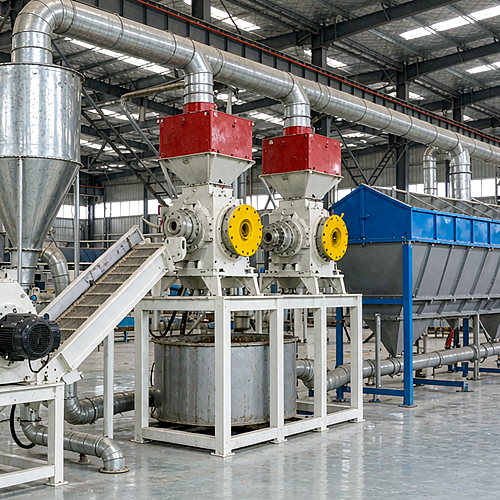
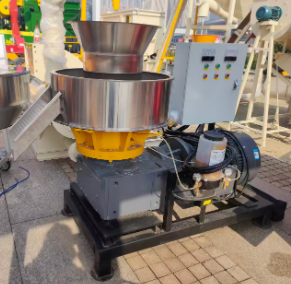
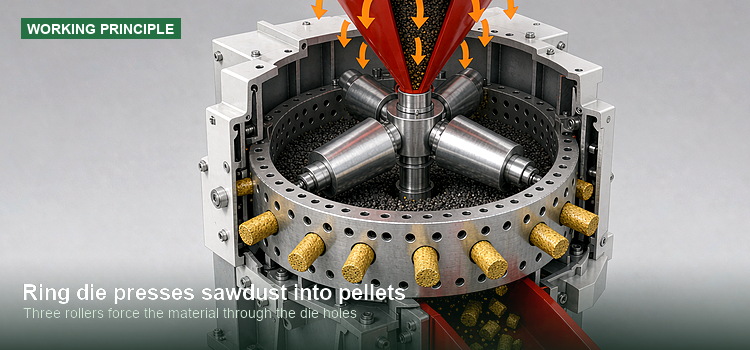
4. Pelletizing. The dried sawdust is fed into the vertical ring die mill. Three tapered rollers run on the inside of the ring and force the material through the die holes; the pellets are cut off at the outer surface by fixed knives. Compression ratio is the setting that decides quality: too low and the pellet crumbles, too high and friction overheats the die, the material scorches and the pellets come out black. We match the ratio to the wood species - pine and poplar press easily, hardwood and rice husk need a harder die.
5. Cooling. Pellets leave the mill at 70-90 degrees C and soft. The counter-flow cooler pulls ambient air up through a moving bed of pellets, bringing them down to within 5 degrees of room temperature; if they are bagged hot they sweat inside the bag and grow mould in the container.
6. Screening. A vibrating screener takes out the fines and broken pellets, which are returned to the mill. Fines in a bag are the first thing a buyer checks, so this stage is not optional.
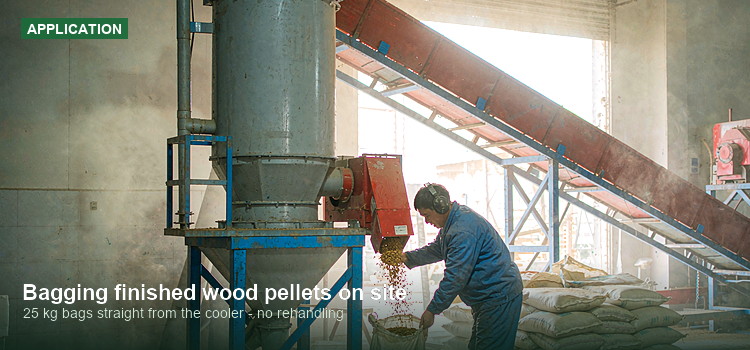
7. Bagging. The finished pellets go to a weighing bagging spout for 25 kg or 50 kg woven bags, then to a sewing head and a bag flattening conveyor. One man runs the whole line from the PLC cabinet.
Detail
The line is built around one number: how many tonnes of finished pellets you want per day. Everything in front of the mill is sized from that number with a deliberate margin.
For 2-3 t/h we use two 470 ring die mills rather than one larger machine. This is not a sales trick - it is the single most useful decision in the whole layout. Two mills mean that when one is down for a die change or a roller rebuild, the plant still runs at half output instead of stopping completely. Die changes are a routine weekly job, and a plant that stops for half a day every week never reaches its monthly target. The same logic applies to the crusher and the hammer mill: we would rather specify one size up than run a machine flat out.
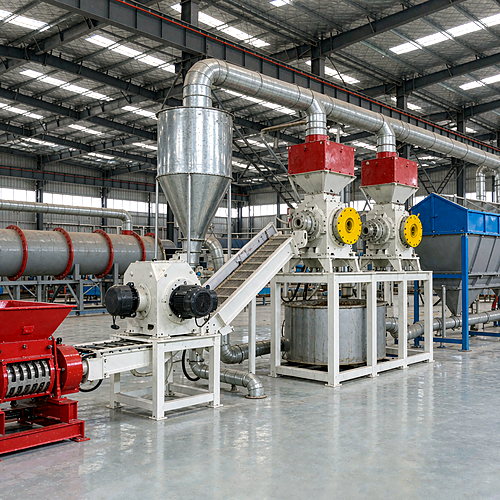
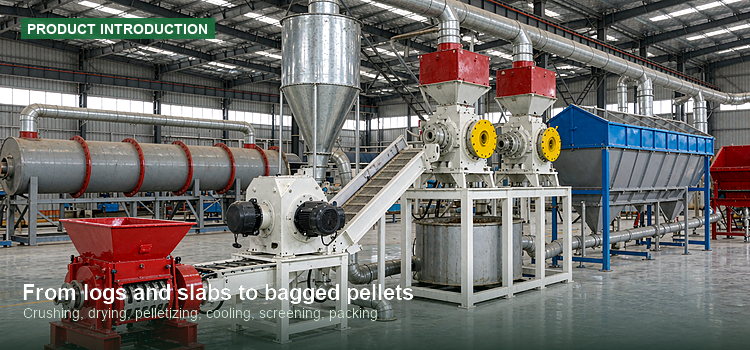
The line is delivered as a set of skid-mounted modules: crushing and grinding module, dryer module with burner, pelletizing module, cooling and screening module, packing module, plus the ducting, cyclones and the PLC cabinet. Foundations are simple concrete pads, the modules bolt together on site, and the ducting is supplied pre-formed so there is no fabrication in the customer's yard.
Commissioning is done by our engineers on site: cold run, then material run, then die and roller adjustment on the customer's own raw material until the pellets meet the agreed spec. Operators are trained during that week, not from a manual.
What we ask before quoting: raw material type and size, its moisture content summer and winter, the target output per day and per shift, the required pellet diameter, the local voltage and frequency, and whether the customer needs the pellets packed or in bulk. Get those six answers and the configuration writes itself.
Product Details and Packaging
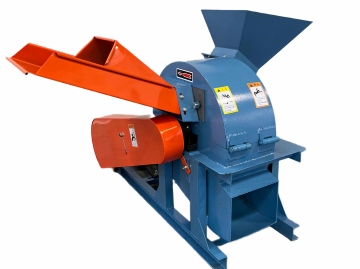
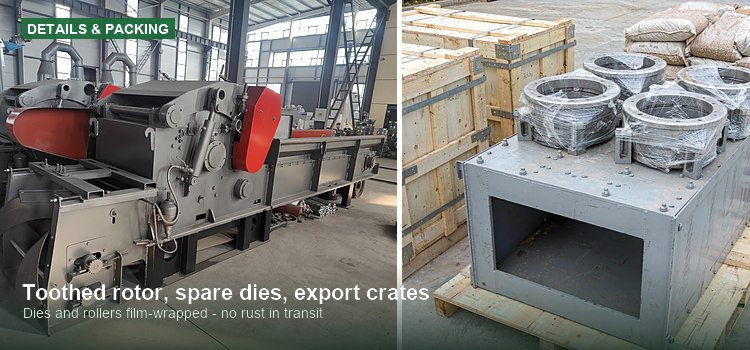
What is on the machine: the crusher runs a heavy rotor with bolt-on blades (hammers optional) on a hydraulic open front, with forced-feed toothed rollers and a tooth-claw chain conveyor - the hydraulic opening is what makes a blocked rotor a five-minute job instead of a two-hour one. The hammer mill uses imported NSK bearings on the main shaft, a sliding door body with a spring-loaded screen frame, and a rotor that can be run in either direction so the hammers wear evenly; a machine that is only ever run one way starts resonating and losing output after a few months, and that is a structural problem, not a maintenance problem.
The ring die mill is the part that wears. Dies and rollers are consumables and are quoted separately so the customer can see the running cost up front - a die typically lasts 800-1,200 hours depending on the material and the compression ratio. We supply a spare die and a set of rollers with every line, because a plant waiting three weeks for a die from China is a plant losing money.
Packing: every module is bolted to a steel skid, the exposed shafts and flanges are greased and capped, electrical cabinets travel in a separate plywood case, dies and rollers are wrapped in anti-rust film and crated. Machines go into 40HQ containers with the frames blocked and strapped to the container floor - no welding inside the container, and no loose parts. A full set of drawings, the electrical diagram and the operation manual in English travel with the shipment, and a spare-parts list with prices is issued with the contract so the customer can stock what he will actually need.
Factory and more information
Zhengzhou Weiwei Machinery has been building feed and biomass machinery in Xingyang, Henan since 1980 - over four decades, in the same industrial zone, under our own two brands WEIWEI and Yingyida.
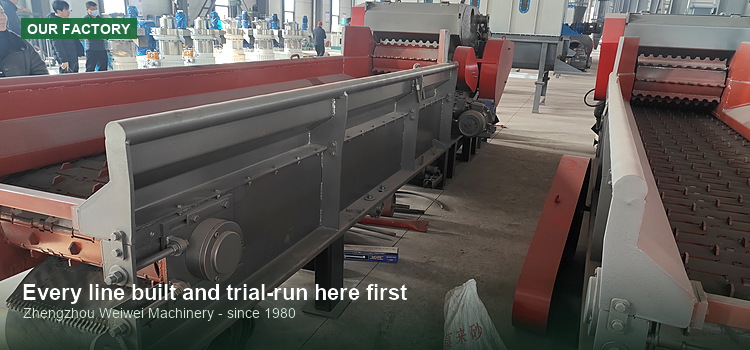
We are a manufacturer, not a trading company. Crusher rotors are machined and balanced in our own shop, frames are cut and welded here, and every line is assembled and trial-run with material before it is dismantled for shipment. That trial run is the reason our commissioning is short: the faults have already been found in Henan, not in the customer's yard.
Certification: ISO 9001 quality system, CE for the European market, and SGS and TUV inspection reports on request. Around 19 patents on crushing, pelletizing and conveying mechanisms. Our own import and export licence means we handle the shipping documents directly.
We export to South America, Africa, Southeast Asia and South Asia, and we keep engineers available for on-site installation and operator training. Spare parts ship from stock in Zhengzhou, usually within a week.
message