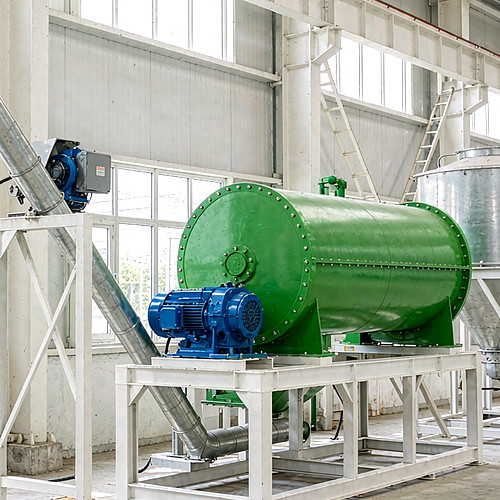
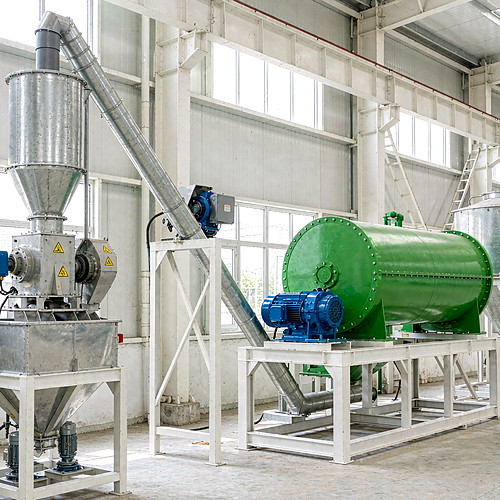
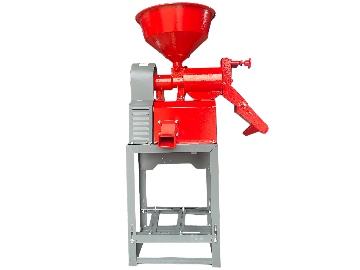
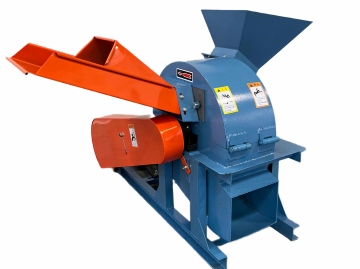
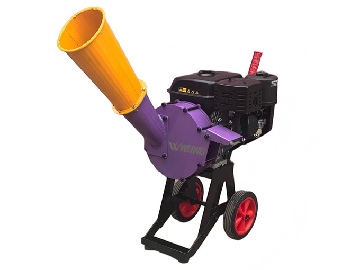
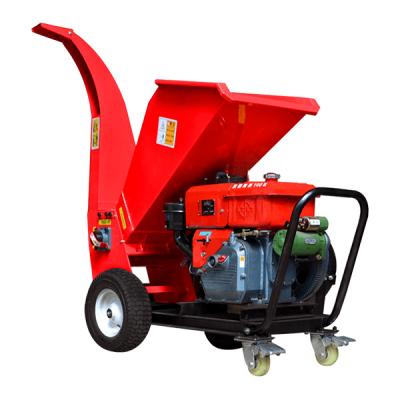
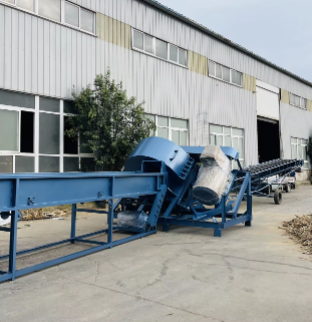
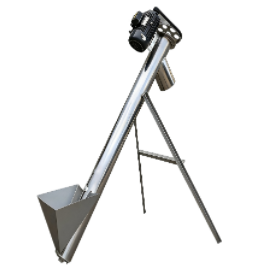
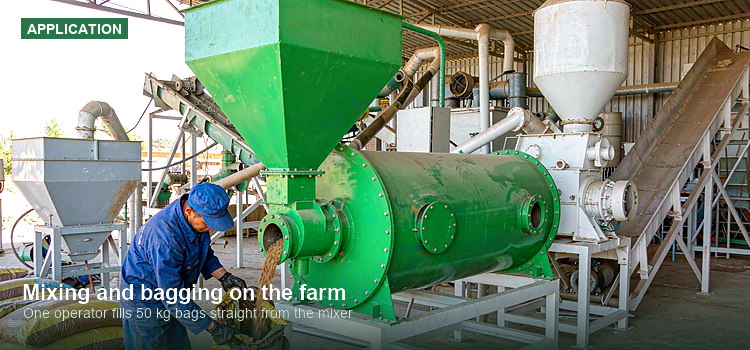
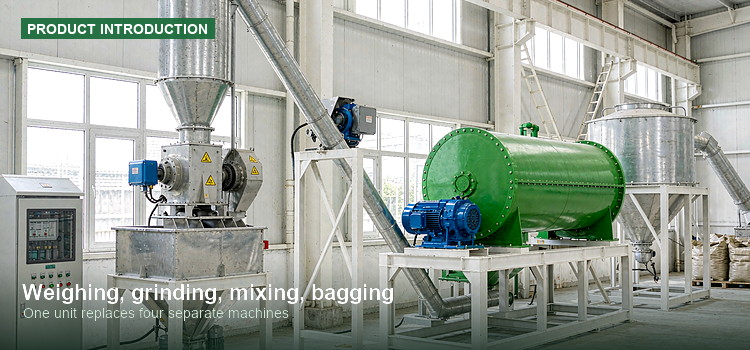
This unit is for the feed you mix yourself. Grain, meals and premix arrive as separate bags; the weighing bin turns them into a formula, the hammer mill grinds them to a 2-3 mm meal, the screw conveyor lifts that meal into the mixer, and three to six minutes later the same material leaves the bagging spout as finished mash feed. No pellet mill, no steam, no cooling — because mash feed is what most poultry, cattle and sheep farms actually use on site.
parameter
Model WW-FM500 WW-FM1000 WW-FM1500
--------------------------- ------------------------ ------------------------ ------------------------
Output (t/h) 1-1.5 2-3 3-4
Batch capacity (kg) 500 1000 1500
Mixing time per batch (min) 3-5 4-6 5-8
Mixer type Horizontal double ribbon Horizontal double ribbon Horizontal double ribbon
Mixer motor (kW) 5.5 7.5 11
Hammer mill model 40-28 50-40 600-60
Hammer mill motor (kW) 11 22 30
Screw conveyor (kW) 2.2 3 4
Dust collector fan (kW) 0.75 0.75 1.5
Screen hole (mm) 1.5-4 1.5-4 1.5-4
Mixing uniformity (CV) under 5% under 5% under 5%
Total installed power (kW) 19.5 33 46.5
Weighing bin volume (m3) 0.8 1.5 2.5
Floor space L x W x H (m) 6 x 3 x 4 8 x 4 x 5 10 x 4.5 x 5.5
Shipping 1 x 40HQ 1 x 40HQ 2 x 40HQ
Standard configuration, quoted per model. Final mixer size, hammer mill power and layout are confirmed against your raw material, required fineness, bag size and local voltage before the contract.
principle
1. Weighing. Each raw material is loaded into the weighing bin, which stands on four shear-beam load cells. The formula is set by weight, not by volume, because the bulk density of bran and of corn meal differs by nearly half — volumetric batching is the main reason farm-mixed feed slowly drifts away from its formula.
2. Grinding. The weighed material drops into the hammer mill and is ground against a 1.5-4 mm screen. The mill discharges into a cyclone; the dust-laden air then goes to a pulse-jet bag filter, so the workshop stays clean and the fines are recovered instead of settling on the floor.
3. Conveying. An inclined screw conveyor lifts the ground meal into the mixer inlet. Because the conveyor runs closed, nothing is lost between mill and mixer, and no operator has to carry bags up a ladder.
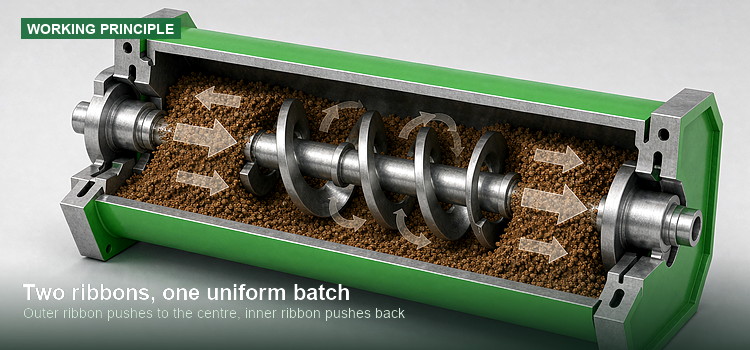
4. Mixing. The mixer is a horizontal double-ribbon type. The outer ribbon pushes material from both ends towards the centre while the inner ribbon pushes it back outwards, so the whole batch circulates as a loop instead of being stirred in place. After 3-6 minutes the coefficient of variation is below 5 %, which is what stops a premix from separating again inside the bag.
5. Discharging. The bottom gate opens and the batch falls through the bagging spout. Bags of 10-50 kg are filled and sewn, and the empty mixer is ready for the next batch.
Detail
A mash feed unit is not one machine but four that have to match: a scale, a mill, a conveyor and a mixer. Buying them separately is where small feed plants lose money — the mill is faster than the mixer, the conveyor is smaller than the mill, and the controls are three cabinets with three sets of buttons.
WEIWEI builds the four as one unit on one frame, sized so that nothing becomes a bottleneck: hammer mill output matches the batch, the screw conveyor matches the mill, and the mixer batch matches the bagging rhythm. One cabinet starts and stops the sequence in the right order, so meal never backs up in a chute.
Why a horizontal ribbon mixer rather than a vertical one: a vertical screw mixer is cheaper, but it mixes by lifting material up a central screw and letting it fall. That leaves dead corners, keeps 2-3 % of the previous batch inside, and wraps long fibre such as grass meal or straw meal around the screw. The double-ribbon horizontal mixer moves the whole batch along the trough, so residue stays under 0.5 %, fibre does not ball up, and a 500 kg batch is uniform in 3-5 minutes.
The unit is built to be extended: a second weighing bin for a second formula, a liquid line for oil or molasses, a finished-feed silo instead of direct bagging, or a pellet mill downstream once the farm starts selling pelleted feed.
Product Details and Packaging
Details that decide whether the unit still runs in ten years:
- Ribbon and shaft. Thickened ribbon flights welded to a seamless shaft, both ends turned; outer and inner ribbons are opposite-hand so the batch circulates instead of being pushed to one end.
- Shaft sealing. Packed gland plus an outboard bearing housing, so dust cannot reach the bearing and grease cannot reach the feed.
- Drive. Gear motor with a ZQ-series reducer and a guarded chain drive — no exposed chain, no V-belt to re-tension.
- Weighing. Four shear-beam load cells under the bin with the indicator in the cabinet; the cells are protected against side load when a loader tips material in.
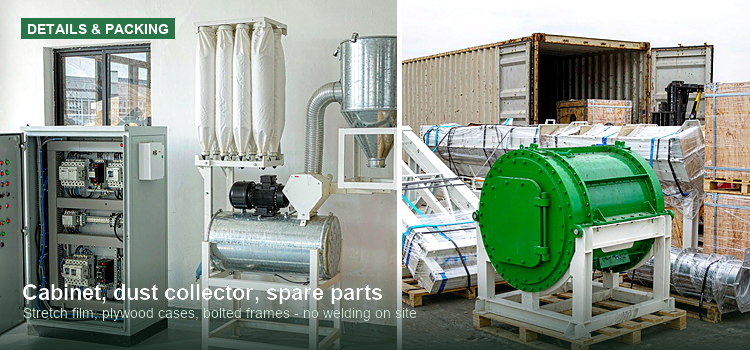
- Dust control. Cyclone plus pulse-jet bag filter on the mill discharge; filter bags come out from the top without tools.
- Control cabinet. Thermal overload on every motor, interlocked start sequence, emergency stop on the door, and a manual position for each unit so one machine can run during maintenance.
- Spare parts shipped with the unit. One set of screens, one bearing set, one shaft seal kit and a box of shear pins.
Packing and shipping:
Each unit is wrapped in stretch film; motors and the control cabinet travel in plywood cases; the ribbon shaft is braced inside the trough so it cannot move in transit. You receive the layout drawing, foundation and anchor-bolt plan, lifting points and the container loading list before shipment. Bolted frames mean no welding on site — the unit is assembled to the drawing and commissioned to rated output. A WW-FM500 or FM1000 ships in one 40HQ; the FM1500 needs two.
Factory and more information
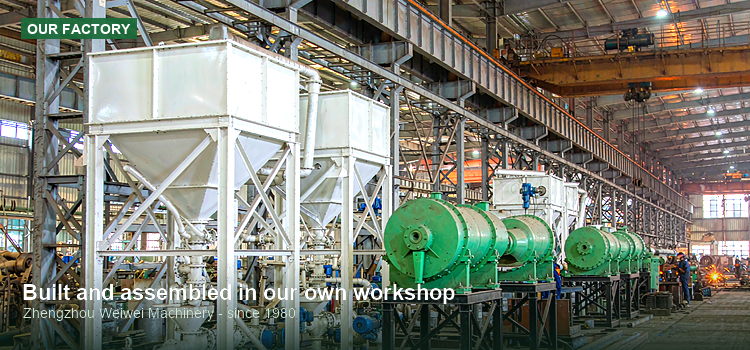
Zhengzhou Weiwei Machinery Co., Ltd. has been building feed machinery in Xingyang, Henan since 1980. Ribbon mixers, hammer mills, screw conveyors, bins and control cabinets are cut, welded, machined and assembled in our own workshops, so the fit between units — and the spare part five years later — stays under our control instead of a supplier's.
The company holds ISO 9001, CE, SGS and TUV certificates and more than 19 patents. Feed units and complete lines have been exported to Africa, Southeast Asia, the Middle East and South America, running on 380 V, 415 V and 440 V, in humid coastal air and in dry inland dust.
For a mash feed unit we deliver more than hardware: a layout drawing for your building, foundation and anchor-bolt plan, shipping list, installation supervision, commissioning to rated output and operator training, plus a 12-month warranty and lifetime spare-parts support. If the formula or the capacity changes later, a second weighing bin or a larger mixer can be added without replacing the mill and the conveyor.
message