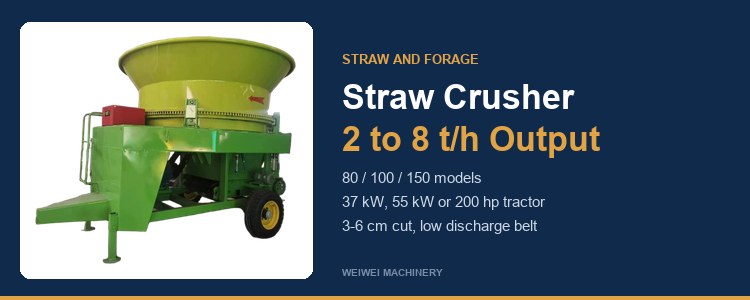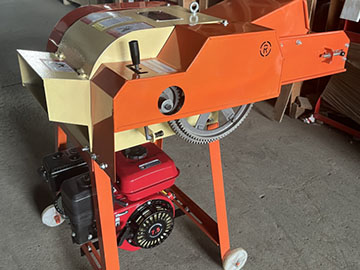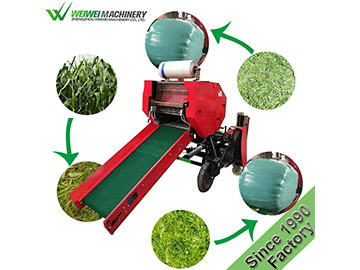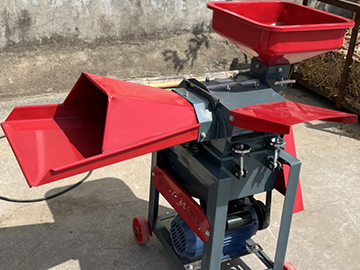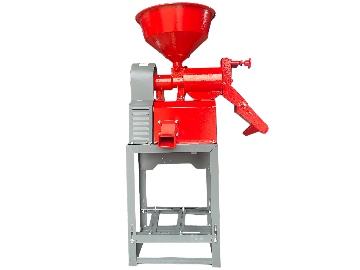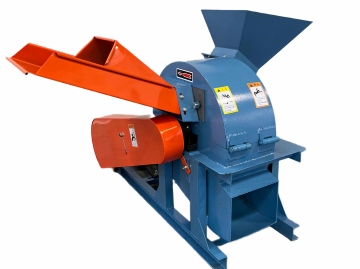

The fix is in the hopper. On the 80-II, 100 and 150 models the hopper is a large drum, 2180 mm, 2600 mm and 3000 mm across at the top, and that drum turns slowly. A gearbox drives it on the 80-II and 100, a BM400 hydraulic motor drives it on the 150. As the drum rotates, the straw inside is carried around and dropped continuously into the hammer chamber below, so the machine is fed at a steady rate instead of in lumps. Under the chamber sit 27, 36 or 66 manganese hammers, and the cut length is set between 3 and 6 cm.
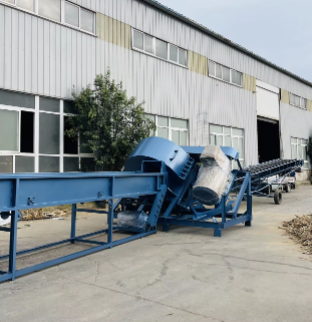
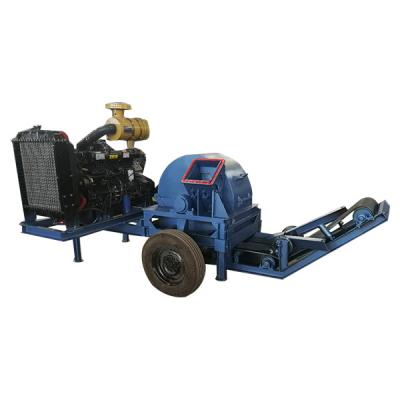
The second decision is where the material goes out. These machines discharge downwards, onto a 1.5 kW belt that carries the chopped straw out under the frame and into a trailer or a windrow. That layout removes the fan and the cyclone, and with them the dust column and the long duct that has to be cleaned out every week. It also puts the outlet near the ground, so one person with one trailer can keep up with the machine. Most farms that switch from a top-discharge unit find they no longer need a second man on the bag.
Choosing between the three is mostly a question of power supply. The 80-II runs a 37 kW motor and gives 2 to 4 t/h, and at 3600 by 2180 by 2120 mm with 225/65R16 tyres it tows behind a small tractor. The 100 model steps up to 55 kW and 3 to 5 t/h, with a star-delta or soft-start cabinet. The 150 is the one for fields with no three-phase supply: a 200 hp tractor drives the rotor through the PTO and a 25.16 pump feeds the hydraulic motors, giving 4 to 8 t/h.
Where the material ends up decides the setting. For cattle bedding, 3 to 5 cm is the range that absorbs best and still spreads; for TMR roughage, the same cut works; for the front end of a briquetting or pellet line, a shorter, more uniform cut is worth the drop in hourly output. Dry straw below 20 percent moisture runs fastest. Silage bales at 60 to 70 percent will go through, but expect roughly half the tonnage and plan the day around it.
Zhengzhou Weiwei Machinery has built agricultural machinery in Henan since 1980, with CE and ISO9001 certification and both electric and tractor-driven versions of the same machine. If you tell us your bale size, moisture and what the straw is for, we can confirm which model fits and what the cut length should be set to before you order.