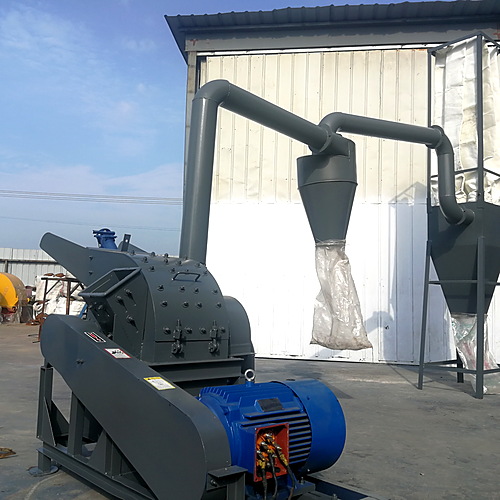
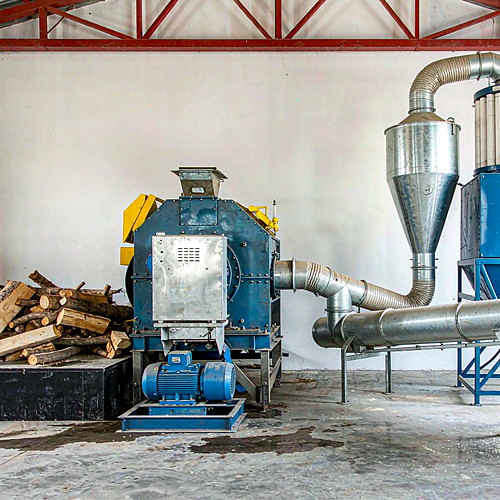
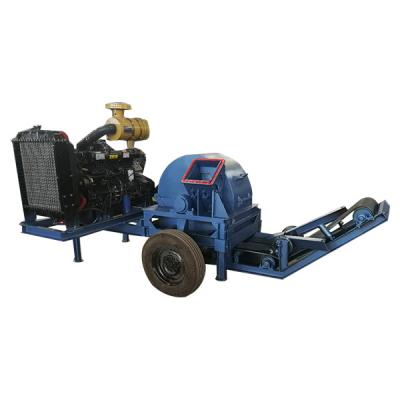
This set exists to turn wood residue into sawdust of a size somebody else will pay for. Slabs, edgings, pallet scrap, branches, bark, corn cobs, corn stalks, straw, rice husk and bamboo all go in at the top chute; sawdust comes out of the cyclone at the other end, straight into a bag or onto a pile.
Who buys it and what they do with the output:
- Charcoal briquette plants. Sawdust is the feedstock for machine-made charcoal; too coarse and the briquette crumbles, too fine and the press cannot vent the air out. A 0.5-3 mm cut with a small share of fines is what most briquetting lines want, and that is set by the screen, not by the machine size.
- Particleboard and MDF mills. They buy sawdust by the tonne and specify a size range; a mill with its own grinder stops depending on whoever is selling that week.
- Biomass pellet plants. Sawdust under 5 mm feeds a ring die mill directly; anything coarser has to be reground, and a plant that regrinds loses a shift.
- Mushroom and edible fungus farms. They need a consistent, dust-free substrate, so the cyclone and bag filter matter as much as the grinder.
- Sawmills and woodworking shops. They already have the residue and are currently paying to have it hauled away. One grinder turns a disposal cost into a saleable bag.
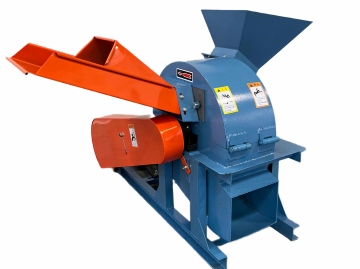
The machine is a multi-function type: alloy blades cut, swinging hammers break, and the rotor throws a high-speed air stream that carries the fines out through the screen. Because the material is cut first and hammered second, stringy bark and green branches do not wrap around the shaft the way they do in a plain hammer mill - which is the difference between a machine that runs all day and one that is opened up twice a week.

parameter
Model DJM-420 DJM-500 DJM-600
----------------------------------------------------------------------------------------------------------------
Capacity (t/h) 0.6-1 1-2 1-3
Main motor (kW) 11-15 18.5-22 37-45
Main shaft speed (r/min) 2300 2300 2700
Blade number (pcs) 4 4 4
Blade material alloy steel alloy steel alloy steel
Hammer type carbon steel, double-ended carbon steel, double-ended carbon steel, double-ended
Screen hole (mm) 1-10, changeable 1-10, changeable 1-10, changeable
Output fineness (mm) 0.5-5 0.5-5 0.5-5
Feed opening (mm) 150 180 200
Cyclone diameter (mm) 600 800 1000
Filter bags (pcs) 12 24 36
Cyclone fan (kW) 3 4 5.5
Screw conveyor (kW) 1.5 2.2 2.2
Dust collector (kW) 1.5 1.5 1.5
Total installed power (kW) approx. 23 approx. 34 approx. 60
Floor space L x W x H (m) 4 x 2.5 x 3.5 5 x 3 x 4 6 x 3.5 x 4.5
Shipping 1 x 20GP 1 x 20GP 1 x 40HQ
Standard configuration, quoted per model. Screen hole size is chosen against the fineness your buyer asks for; cyclone diameter, filter bag count, feed opening and floor space are re-checked against your material and site before the contract. Installed power is the sum of the motors in the standard configuration.
principle
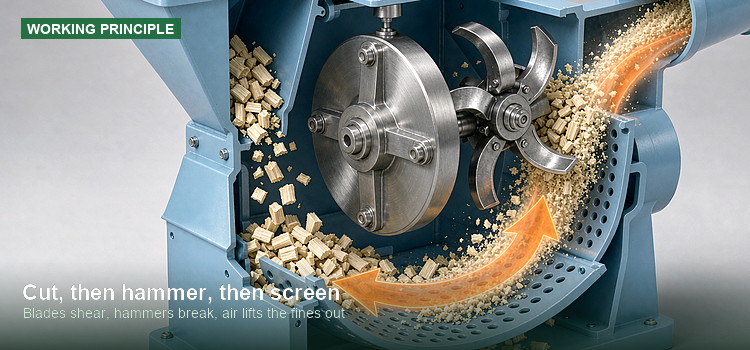
1. Feeding. Material goes in through the top chute by hand or from a belt conveyor. The chute is shaped to throw the pieces into the rotor instead of letting them sit on it, which is what causes the bounce-back and the occasional piece flying out of the top.
2. Cutting. Four alloy blades are bolted to the rotor disc. They shear the material across the full width of the working chamber - hard, wear-resistant, and longer-lived than plain steel blades, which is why the output stays up for months instead of dropping off after the first set is blunt.
3. Hammering. Between and behind the blades, carbon-steel hammers swing on pins and hit whatever the blades did not cut cleanly. Each hammer can be turned round and used on its second face when the first is worn - but it is turned in the same position, never swapped from pin to pin, because moving hammers around upsets the balance of the rotor.
4. Second pass. Lining plates on the working chamber throw the material back into the rotor for a second impact instead of letting it shoot straight through. That is where the capacity comes from on fibrous material: the same piece is hit twice in one pass.
5. Screening. A curved perforated screen under the rotor decides the finished size. Change the screen and the same machine gives you coarse chips for a board mill or 0.5 mm powder for briquetting. Nothing leaves the chamber until it is small enough to pass.
6. Air conveying. The rotor itself is the fan. At 2,300-2,700 r/min it throws a high-speed air stream that lifts the fines off the screen, carries them up the outlet duct and does the conveying for you - no separate blower, no additional dust source. Heavier or oversized pieces simply fall back for another pass.
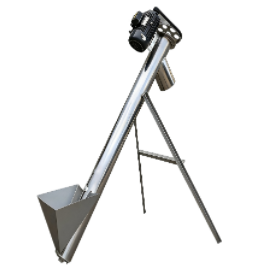
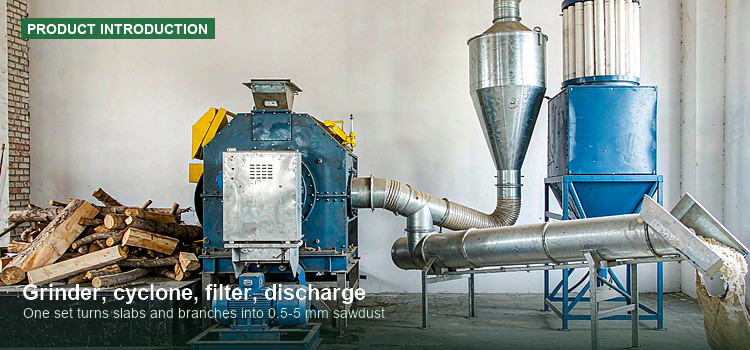
7. Separation and collection. The air and sawdust mixture enters the cyclone, where the material drops out of the airstream and falls to the discharge; the dusty air goes on to the pulse-jet bag filter and leaves clean. The screw conveyor under the cyclone fills bags or feeds a pile, and the whole point of the cyclone is that the operator is not standing in a cloud of dust.
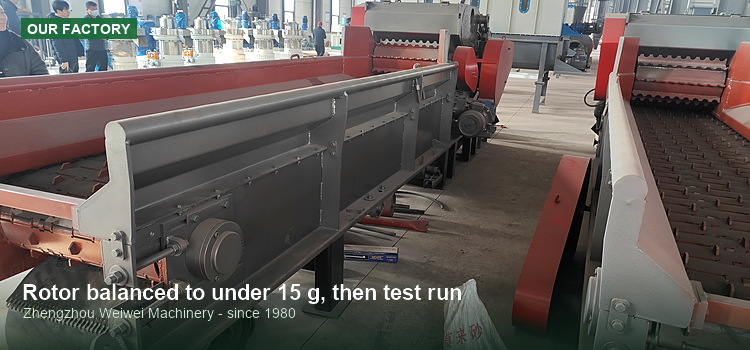
8. Balance. Every rotor is balanced on a dynamic balancing machine before assembly; the weight error is held under 15 g. An unbalanced rotor is not just noisy - it is the reason a grinder starts vibrating, cracks its bearings and loses output after a few months of work.
Detail
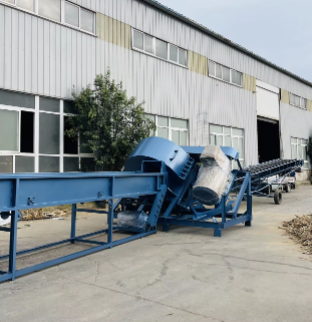
The set is built as one skid: grinder, cyclone, dust collector, ducting and discharge conveyor, delivered assembled as far as shipping allows and bolted together on site. There is no separate blower to align, because the rotor does the air work itself.
How to choose the size. Work back from what your buyer will accept. If you sell to a briquette plant, start from the die on their press and pick the screen that gives the size they want; then pick the model whose capacity at that screen matches your daily tonnage. A DJM-500 held at 1.5 t/h with a 3 mm screen will produce more usable material in a week than a DJM-600 run flat out with the wrong screen, because the oversized fraction has to be reground.
What the three models are for. DJM-420 (11-15 kW, 0.6-1 t/h) for a farm, a small briquette workshop or a mushroom base - single phase is not available, but the machine will run off a modest generator. DJM-500 (18.5-22 kW, 1-2 t/h) is the volume seller: enough output for a small charcoal plant or a board mill's own use, still on a 20GP container. DJM-600 (37-45 kW, 1-3 t/h) for a plant that sells sawdust as a product and needs to fill bags all day.
What you get. Grinder on its base frame with motor and guard, cyclone with stand, pulse-jet bag filter with bags and cages, flexible and rigid ducting, screw discharge conveyor, one control cabinet, one set of spare blades, one spare screen, foundation drawing, electrical diagram and operation manual in English.
What we ask before quoting: what the material is (softwood, hardwood, bark, straw, corn cob), its size and moisture, the finished fineness your buyer specifies, the tonnes per hour you actually need to sell, and the local voltage. Moisture above about 20 % slows the machine and blinds the screen, so for green branches we usually recommend drying first or running a coarser screen.
Product Details and Packaging
The parts that decide how long the machine lasts:
Blades. Alloy steel, four per rotor, bolted so they can be removed individually. A blunt blade does not just cut slower - it starts hammering the wood, which raises the temperature, softens the material and fills the screen with a paste. We supply one spare set with every machine.
Hammers. Carbon steel, double-ended. Wear one face, turn the hammer round, wear the other, then replace. The one rule we insist on: turn it in place. Moving hammers from pin to pin to "even out the wear" is the fastest way to destroy the balance of a rotor.
Lining plates. Bolted into the working chamber. They throw material back into the rotor for the second impact and protect the housing at the same time. They are consumables, they are cheap, and they should be checked whenever the blades are changed.
Screen. One spare ships with the machine. Screens are punched to the fineness the customer sells, so a customer who changes markets changes screens, not machines.
Rotor balance. Balanced dynamically before assembly, weight error under 15 g. This is the number that separates a machine that still runs quietly in year three from one that has been re-bearinged twice.
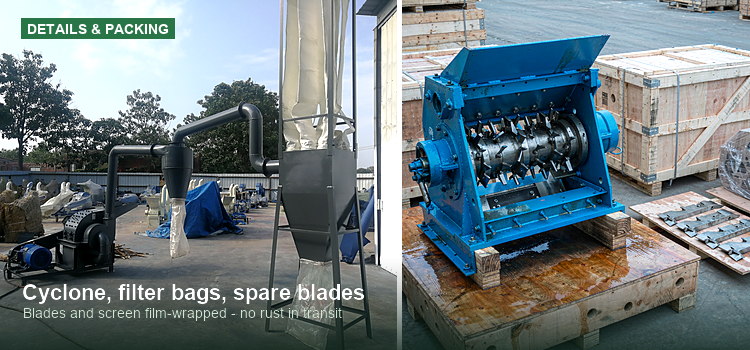
Packing. The grinder is bolted to a steel skid on a plywood-bottomed pallet, the rotor is locked, exposed shafts and flanges are greased and capped, blades and screens travel in a separate crate wrapped in anti-rust film. Cyclone and ducting are nested to save container space; the bag filter ships with its bags boxed separately. Everything is strapped to the container floor - no welding inside the container, no loose parts. Drawings, electrical diagram, manual in English and a priced spare-parts list travel with the shipment.
Factory and more information
Zhengzhou Weiwei Machinery has been building feed, biomass and forestry machinery in Xingyang, Henan since 1980 - more than four decades in the same industrial zone, under our two brands WEIWEI and Yingyida.
We machine and balance the rotors ourselves, cut and weld the frames here, and assemble and test-run every set with material before it is dismantled for shipment. That is why commissioning on site is usually a day: the faults have already been found in Henan.
Certification: ISO 9001 quality system, CE for the European market, SGS and TUV inspection reports on request, around 19 patents on crushing, grinding and conveying mechanisms, and our own import and export licence so the shipping documents are handled in-house.
Export markets: South America, Africa, Southeast Asia and South Asia. Engineers are available for on-site installation and operator training, and spare parts ship from stock in Zhengzhou, normally within a week.
message