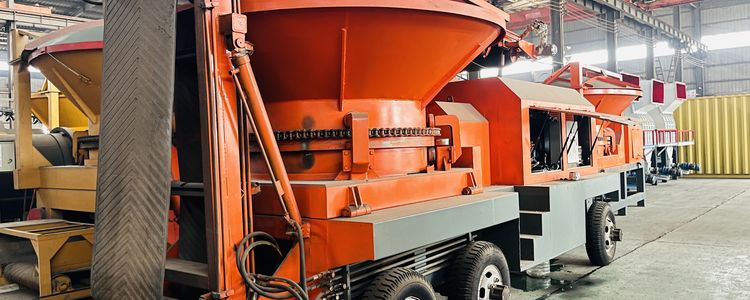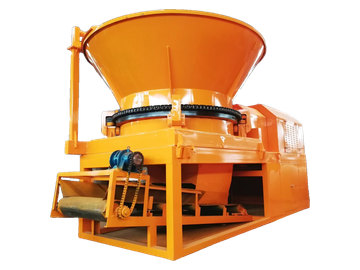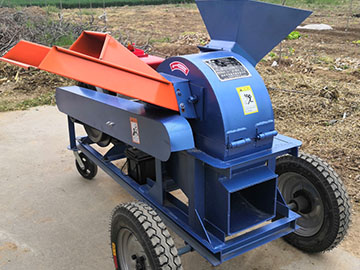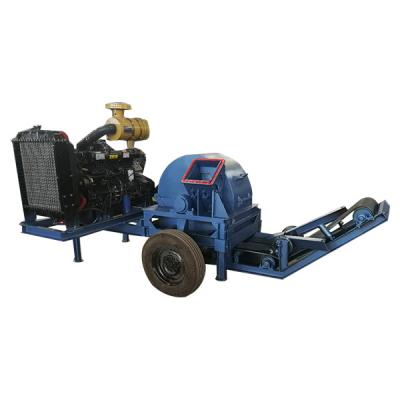

The stump crusher in the photograph is built as a towed unit rather than a skid. A wide rotating feed bowl sits at the rear, sized so that a whole stump can be dropped in by a small excavator or a telehandler without being cut down first. A hydraulic arm above the bowl holds and turns the piece while it is being worked, which is what stops a round, wet stump from spinning on the rotor instead of being cut. Below the bowl is the cutting chamber, and behind it the diesel tank and the control bank. The chassis carries two or more axles and a drawbar, so the machine can be pulled on a public road behind a farm tractor and set to work within a few metres of the stump it is meant to destroy.
Cutting, not hammering, is the principle. A hammer mill breaks material by impact, and wet root wood with grit in it absorbs that impact and wears hammers quickly. A stump crusher cuts and shears at low speed with high torque, which produces a coarse chip and mulch rather than a fine powder, and keeps the cutting edges in contact with clean wood instead of with soil.
Soil and stone are the real cost of the job, not the wood. Grit that travels through the chamber with the chips will dull an edge in a shift that would otherwise last a week, and the operator who shakes a root out over a concrete pad before loading it will spend less on knives than the one who does not. The same rule applies to the site: clear the stone from around the stump before the bowl is filled.
The output has three uses, and the cheapest one needs no market at all. Chips spread back over the cleared ground return organic matter and reduce the cost of buying fill or mulch. Screened chip can be sold as biomass feedstock where a boiler or a pellet line is nearby. And the mulch fraction goes to landscapers who pay for a product measured in cubic metres rather than tonnes.
Zhengzhou Weiwei Machinery has built wood and agricultural machinery in Henan since 1980, with CE and ISO 9001 certification, and we supply both skid-mounted and towed stump crushers. If you are clearing an orchard, a building plot or a logged site, tell us the stump diameter, the species, the soil type and how far the nearest road is — we will tell you whether a towed unit pays for itself on your site or whether a skid machine with a tractor and trailer is the cheaper answer.