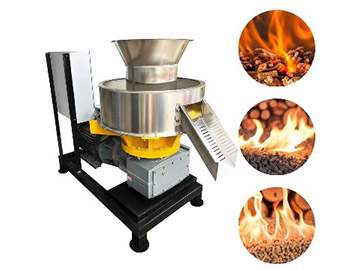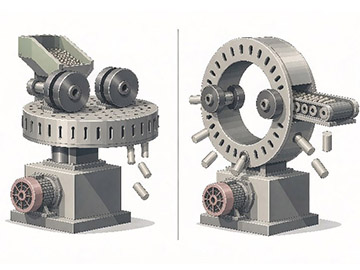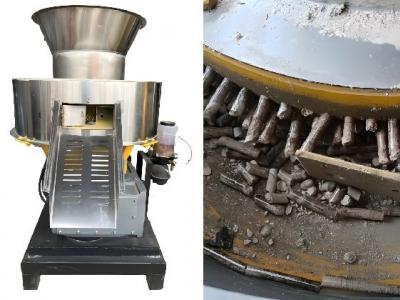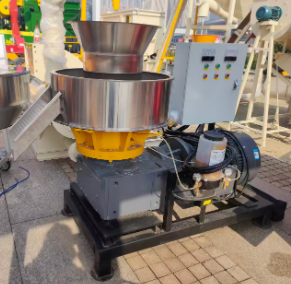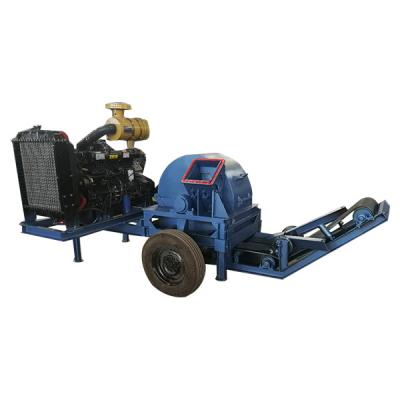

The limit is geometry. On a flat die the material sits on the plate and the roller has to keep pushing it inward towards the track. The outer ring of the die does most of the work and the centre of the plate does much less, so a large share of the die area is idle. Push the machine harder and the working band gets hot, the wood lignin softens too early, and the die blinds over.
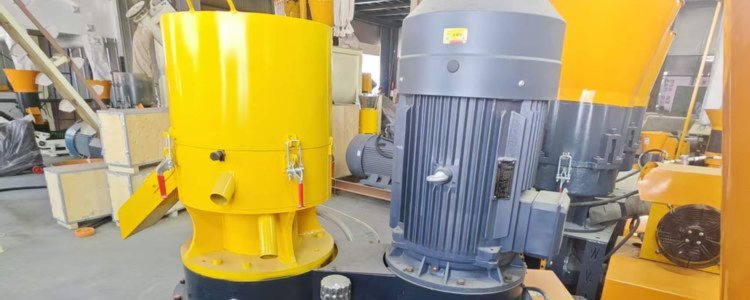
The vertical ring die solves it by turning the working surface into a ring. The die is a horizontal ring, the rollers sit inside it and travel around the inner face, and centrifugal force throws the material outward against the die wall. Every part of the die sees the same load as the rollers come round, so the die wears evenly, the heat is spread over a much larger area, and output per kilowatt rises. The 550 frame uses this layout: die housing on the left, main motor coupled on the right, both on a common cast base that can take wheels.
The number that matters is the compression ratio. A die is described by hole diameter against hole length, and for sawdust the usual band is roughly 1 to 6 up to 1 to 8. Too short and the pellet comes out soft and crumbles in the bag. Too long and the press stalls or the die plugs. A ring die with the wrong ratio will underperform a flat die with the right one, which is why the die is ordered against the material, not against the machine.
Roller gap is the second setting. The clearance between roller and die sits in the region of 0.1 to 0.3 mm. Too wide and the material is not gripped; too tight and the roller and die grind each other. Check it with a feeler gauge and reset it after the first hours on a new die.
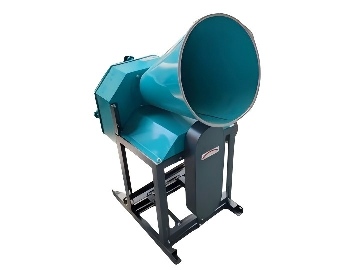
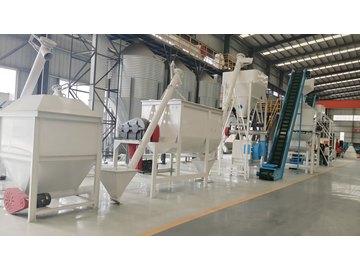
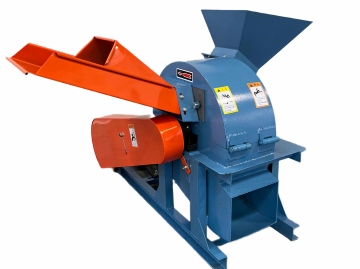
Feed condition decides the rest. Sawdust at 12 to 15 per cent moisture and 3 to 5 mm particle size presses well; the hammer mill and the dryer in front of the press are what make the die last.
Zhengzhou Weiwei Machinery has built pellet, feed and wood machinery in Henan since 1980, with CE and ISO 9001 certification. Send us the material, the moisture and the tonnage you need, and we will tell you whether a flat die SKJ or a ring die frame is the honest answer for your plant.