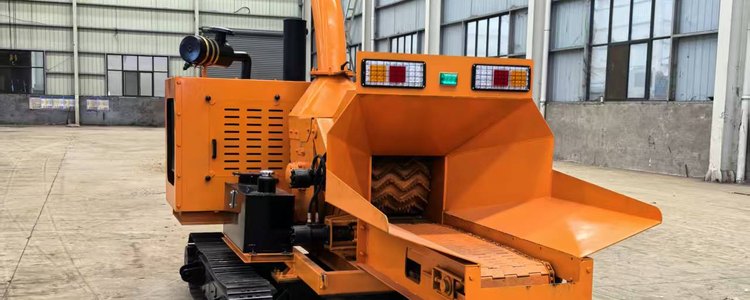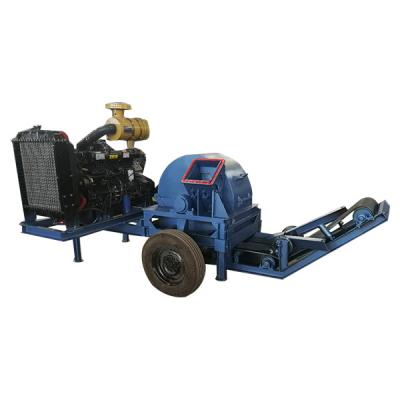

The tracked chipper in the photograph solves that with the undercarriage before it solves it with the engine. Two steel-cleated rubber belts carry the machine, and because the contact area is long rather than a few square centimetres under a tyre, the ground pressure drops sharply. That is the difference between a machine that digs itself in on soft ground and one that crosses it. The belts also let the unit drive itself from the truck to the pile, turn inside an orchard row, and work on a bank where a towed unit could not be positioned at all.
Above the tracks sits the working half: an orange feed hopper wide enough for a bundle of branches rather than a single stem, a pair of hydraulic feed rollers that pull the material in against the rotor, the cutting drum itself, and a discharge spout that can be turned to throw chips into a trailer, onto a windrow between the rows, or straight back onto the ground as mulch. The control bank stands at the side, where the operator can watch the hopper mouth and reach the emergency stop without walking round the machine.
The feed rollers matter more than the engine size on this class of machine. A rotor that grabs material uncontrolled will stall or throw it back out of the hopper, and the operator learns to feed thin and slow. Rolls that grip the branch and hold it to a steady feed rate let the same rotor cut at its rated speed, with fewer stalls and a more even chip. On a tracked unit this is also a safety point, because the operator is standing on a slope and cannot step back quickly.
The machine earns its cost in three kinds of work. Orchard and vineyard prunings that used to be burned or piled at the headland become mulch spread under the trees, which holds moisture and suppresses weeds. Roadside and riverbank maintenance crews chip the cuttings and blow them into the truck body, cutting the number of trips to the disposal site. And forestry thinning on steep ground, where a forwarder cannot reach, is chipped in place and blown uphill or downhill to a point where a truck can load.
Zhengzhou Weiwei Machinery has built wood and branch chipping machinery in Henan since 1980, with CE and ISO 9001 certification, and our branch chipper range includes towed, tractor-mounted and tracked versions on the same cutting principle. Tell us the branch diameter, the slope you work on, the ground condition and where the chips have to go, and we will tell you which undercarriage and which feed arrangement fits the job.