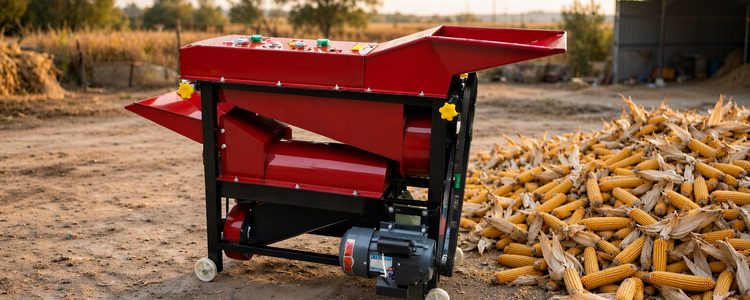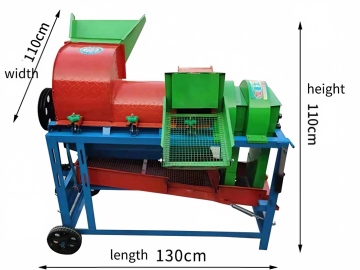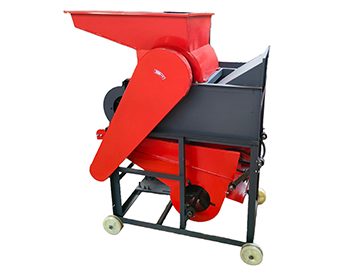

Maize harvested at 25-30% moisture will not wait. The husk wraps each cob like a sealed bag, so a heap picked on Monday is still damp inside on Thursday, and every day of delay means more drying fuel and a shorter step to mould. Hand peeling rarely clears more than a few hundred kilos in a working day for a whole family, which is why so much wet corn is stacked husk-on in the yard and quietly loses value. The 3 kW peeling and threshing unit (3KW-2-130) is rated at 2,000 jin of wet corn cobs per hour, about one tonne. Cobs drop into the hopper at the right-hand end and pass between rubber peeling rollers that grip the husk, tear it away and pull off the silk; the threshing section behind the rollers beats the kernels off the cob, throws the bare cobs out of the side chute and lets kernels and husk leave through separate outlets. Because the rollers do the peeling rather than a beater, kernel damage stays low and few grains end up cracked in the heap. The complete unit measures 1.42 x 0.5 x 0.7 m and rides on four castors, so it passes a normal doorway and can be parked under a shed between loads instead of taking up a barn. Roller clearance and the concave gap are adjustable, which matters when one village delivers small local cobs on Monday and long hybrid cobs on Tuesday. Drive is by belt from a single 3 kW motor: two bearings, one belt and rubber rollers that are replaced in pairs - a maintenance routine a farm mechanic can handle without a manual.