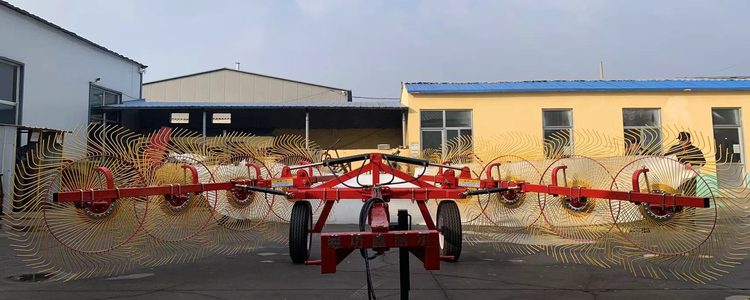

The hydraulic wheel rake does the job with one tractor and one operator. It is a towed implement: the drawbar couples behind the tractor, the frame carries the finger wheels, and the working width comes from how many wheels are on the frame. Three sizes are built — 5.5 m on 8 wheels, 6.5 m on 10 wheels, 7.5 m on 12 wheels — so the same design covers a 20-hectare hay block and a smallholder who cuts two hectares of grass between the trees.
Each size comes in two builds. The standard build uses the small bent-arm wheel suspension, small tyres and a 100 × 100 mm hitch, at 830 kg, 930 kg and 1,050 kg for the three widths. The heavy build swaps to large bent arms, large tyres and a 100 × 150 mm hitch, which takes the weights to 1,000 kg, 1,100 kg and 1,200 kg. The heavy build is the one for stony ground and for contractors who rake every day of the season; the standard build is the one for a mixed farm that rakes a few weeks a year.
The finger wheels are the working part, and they are spring steel. Each wheel runs at an angle to the direction of travel, so the tines sweep the hay sideways into a single windrow instead of pushing it forward. Because the tines flex, a stone or a root passes under the wheel rather than stopping the frame — that is the difference between a rake that finishes a stony paddock and one that spends the afternoon with a bent arm.
Hydraulic lift on the wheel arms lets the operator raise the wheels at the headland and lower them again without leaving the seat, which matters when the field has narrow corners or a gateway to cross. For road transport the arms fold, so the machine narrows to a width a tractor can take down a lane.
Weiwei Machinery has manufactured farm machinery in Zhengzhou since 1980, holds CE and ISO 9001, and exports to Africa, Southeast Asia, South Asia and South America. Tell us your tractor's power, the width of your hay block and whether you rake stones or clean ground, and we will confirm the wheel count and the build.
Message us on WhatsApp with your tractor model and field size and we will send the working width, the exact weight, packing dimensions and a price within 24 hours. The full hay and forage range is on our homepage.Sawdust, rice husk, coconut shell, bagasse — every workshop that cuts or mills wood ends up with a heap of it. The heap costs money three ways. It takes floor space that could hold finished goods. It has to be moved, and you pay by volume for something that is 80 % air. And it cannot be sold, because a boiler, a kiln or a charcoal retort cannot feed loose sawdust without half of it blowing straight up the stack.
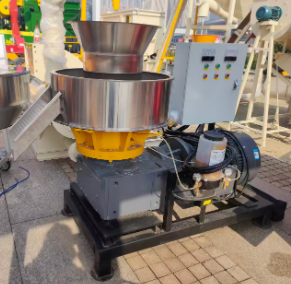
The sawdust briquette machine turns that heap into a product you can stack, weigh and ship. There are three models. The ZBJ-50A runs a 15 kW motor and produces 160–200 kg/h on a 1.5 × 0.6 × 1.6 m frame weighing 600 kg. The ZBJ-50B lifts capacity to 200–300 kg/h with 18.5 kW, on a shorter and wider 1.8 × 0.6 × 1.3 m frame at 700 kg. The ZBJ-70/80 uses the same 18.5 kW motor for 300–400 kg/h and a heavier 750 kg frame, because the larger die needs the extra mass behind it.
The working principle is compression, not chemistry. Material drops from the hopper into a screw propeller that is polished with a wear-resistant welding rod — that hard facing is what keeps the screw alive when the feed contains grit, and it is the part that decides how many thousands of tonnes you get before a rebuild. The screw drives the material through a tapered die, where pressure and the band heaters around the die head soften the lignin in the wood so the particles bond to each other. No glue, no binder, no pallet mill upstream.
The die decides what comes out. A 50 mm die gives the dense log that most biomass boilers and gasifier retrofits are built to take; 70 mm and 80 mm dies give the larger log that charcoal retorts and brick kilns load by hand. The length is set by the operator at the cut-off, so one machine can fill a bag, a crate or a container load without a second tool. Hollow and solid profiles are both available for the same body.
Feed moisture matters more than most buyers expect. Sawdust between roughly 8 % and 12 % bonds well; wet sawdust from a green-wood saw will bind for a minute and then crumble. If your material comes off a saw wet, plan the drying step before the press, not after.
Weiwei Machinery has built farm and biomass machinery in Zhengzhou since 1980, holds CE and ISO 9001, and ships to Africa, Southeast Asia, South Asia and South America. We quote the model against your actual hourly arisings and your finished-briquette spec — tell us what you are pressing, how wet it is and what size log your boiler takes.
Send your material type, moisture and target output on WhatsApp and we will come back within 24 hours with the model, the die size, the motor for your voltage and a delivered price. The full biomass range is on our homepage.