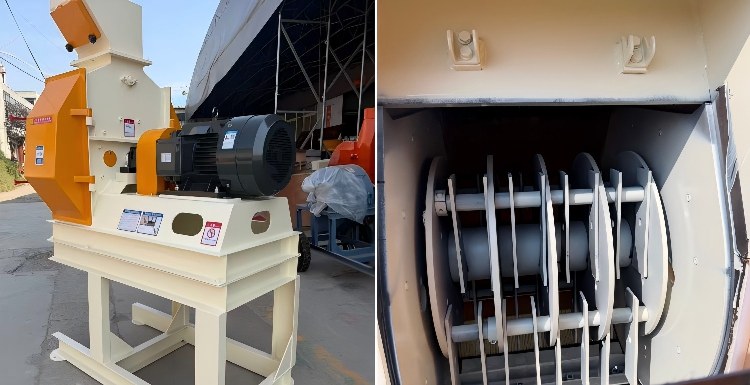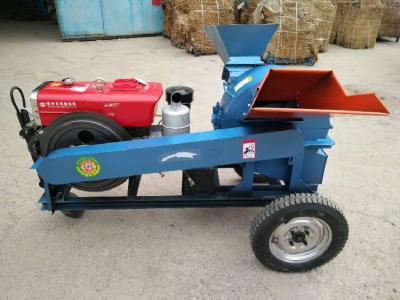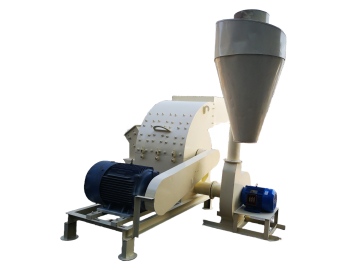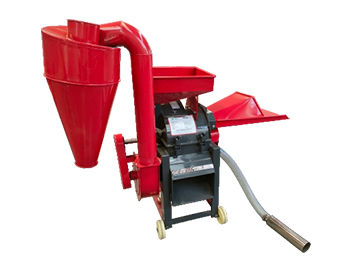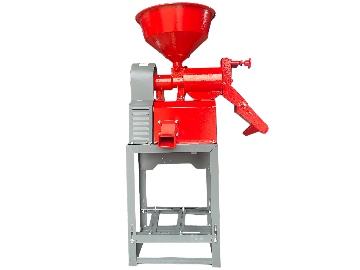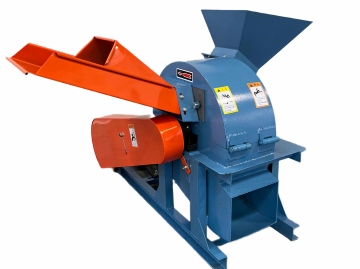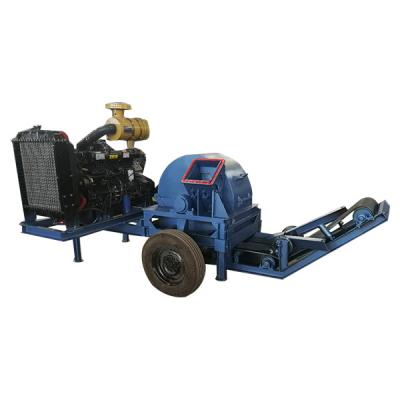

Ask any feed mill operator about grinding, and the complaints sound familiar: output that falls off as the chamber fills up, powder that comes out uneven, a machine that runs hot through a summer shift. Most of these problems trace back to one detail — the round grinding chamber. Material chases itself in circles until it is finer than it needs to be, while coarse particles linger, and power is paid for twice. That is exactly what the new water-drop hammer mill on our assembly floor is built to fix. Seen from the side, the grinding chamber is shaped like a falling drop of water — narrow at the top, widening below. Grain enters tangentially through the feed chute and meets the hammer rotor at full speed, so the chamber profile gives the material two working zones instead of one. A screen wraps a wide arc of the chamber, rows of hardened hammers swing freely on the rotor, and quick-open doors give full access when a screen change is due. Power is delivered through a V-belt drive to a large motor mounted on a heavy welded base. The shape does the work. In the narrow upper zone, incoming kernels are pre-broken at first contact. The widened lower chamber settles the circulating bed of material just enough for a second grinding pass, so particles leave through the screen as soon as they reach the target fineness instead of grinding on. The result is higher output per kilowatt, a more uniform powder and a cooler product that protects vitamins in premix feed. And when a hammer edge wears out, the reversible hammers are simply flipped over, so one set keeps cutting through four working edges.